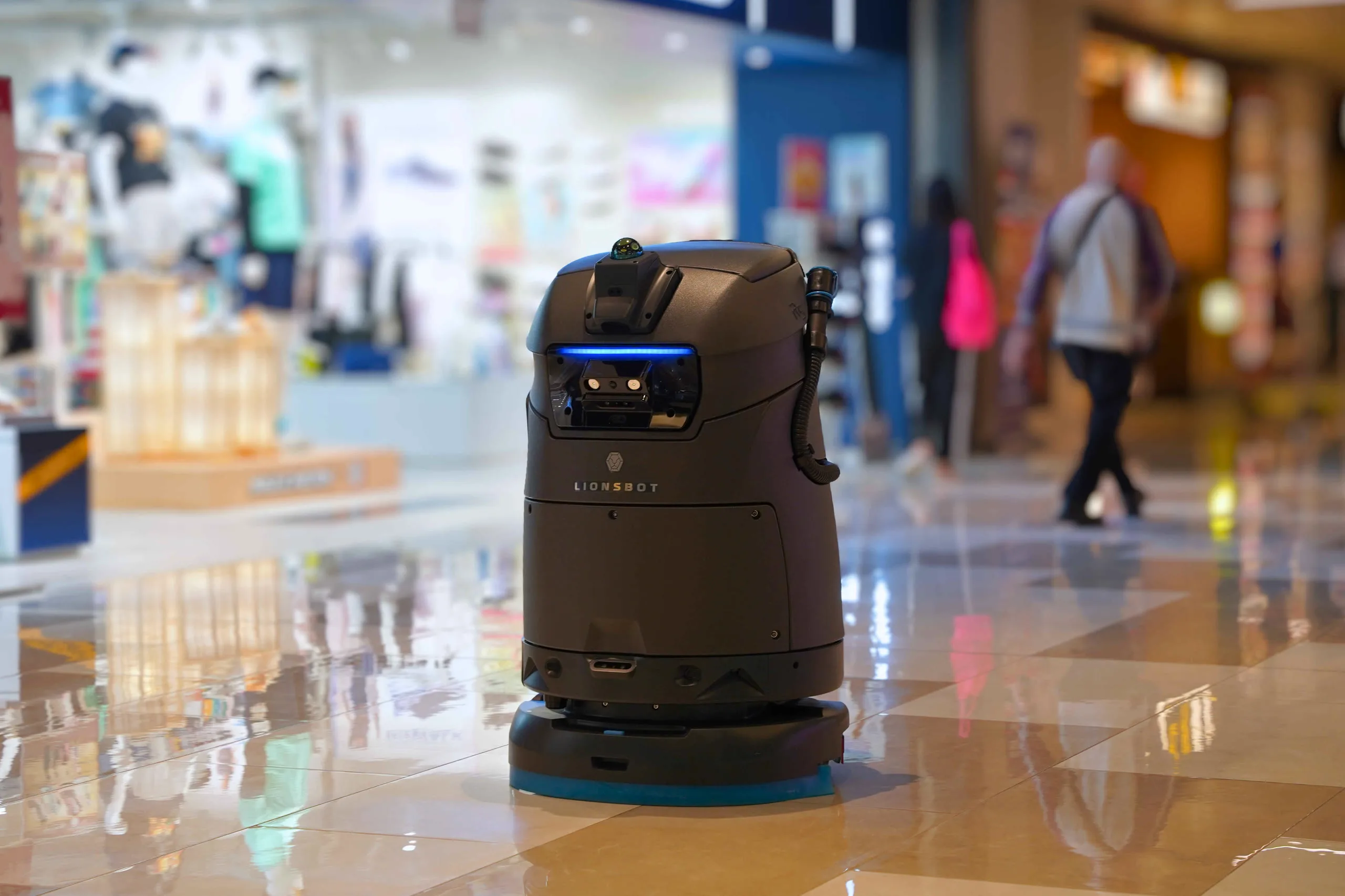
A commercial cleaning robot is a machine that cleans the floor of a working building on its own. It maps the space, follows a route it has been given, drives around the people using the building, and records what it covered. This guide sets out what the category is, how the machines differ from one another, and which figures are worth comparing before you buy.
What it is, and what it is not
The phrase covers machines built for buildings that stay open: terminals, wards, warehouses, malls, teaching blocks and production floors. They are not scaled-up versions of a domestic robot vacuum, and the difference is not only size.
A home robot wanders a few rooms, bumps its way around furniture and empties into a bin. A commercial machine is given a route and holds it across thousands of square metres. It works beside people who are not expecting to make way for it. Afterwards it produces a record the facilities manager can pass on.
The category goes by several names. Robotic cleaning machine, autonomous cleaning robot, industrial cleaning robot and commercial floor scrubber all describe machines in this group. Manufacturers use the terms more or less interchangeably.
Four things separate a commercial machine from a domestic one:
- A saved, repeatable route rather than random coverage
- Tanks, filters and brushes sized for hours of continuous work
- Obstacle detection built for moving people and vehicles, not just furniture
- A coverage log, so the work is evidence rather than assumption
The kinds of machine
Floor cleaning splits into three groups. The names vary between manufacturers; the jobs do not.
Scrubbers put down water and detergent, work it with a brush, then lift it again with a squeegee so the floor is dry behind the machine. They are for hard floor, and they are the largest of the three. The LionsBot R5 covers an average of 1,300 m² an hour, up to 5,000 m² on one charge.
Compact scrubbers do a scrubber's job in the places a full-size machine cannot reach: aisles, corridors, back-of-house routes. The R3 Scrub Pro cleans a 366 mm path, or 682 mm with its side brush fitted, at 800 to 1,200 m² an hour.
Vacuums clean dry. They take carpet as well as hard floor, and they are the quietest, which is what makes them usable while a building is occupied. The R3 Vac runs at 61.7 dB and covers 500 to 1,000 m² an hour.
Most buildings need more than one. A floor is rarely all carpet or all hard floor, and the machine that suits an open concourse is the wrong machine for the gap between desks.
Those three groups cover floors, which is where most of the work and most of the spend sits. The wider category is larger. Sweepers lift dry debris without water. Combination machines sweep and scrub in one pass. Some ranges also include disinfection units, facade and window robots, and service or delivery robots sold alongside the cleaning machines. A manufacturer describing itself as a cleaning robot company may mean any of these, so it is worth checking which part of the range you are being shown.
How they find their way
A commercial robot builds a map of the building and then navigates against it. Position comes from LiDAR, which measures distance with a laser. The R3 Vac's LiDAR covers 25 m. Depth cameras, sonar and time-of-flight sensors handle what the map does not know about, which is everything that moves.
That second part is usually called obstacle avoidance, and it is what decides whether a machine can work in a building that is open. Detecting a person is not enough. The machine has to slow, choose a way past, and then find its route again without help.
What they do not do
This matters more than the feature list, because a robot bought on the wrong expectation gets switched off.
A floor-cleaning robot cleans open floor. It does not clean anything above floor level, it does not climb stairs, and it does not clean inside machinery. It does not replace a cleaning team. It takes the large, repetitive, open-floor part of the work. That is the part that uses the most hours, and the part nobody wants to do by hand.
Judged that way the question is not whether a robot can do everything. It is how many hours of open floor it takes off the team, and whether it does that reliably enough to plan around.
Where they are used
The pattern is consistent: large floor areas, long opening hours, and a cleaning standard somebody checks. That describes airports and transport hubs, hospitals, hotels, malls and retail, warehouses and distribution centres, offices, production floors and campuses.
What changes between them is not the machine so much as the constraint. An airport has no quiet hour. A hospital has a noise limit. A warehouse has forklifts. A campus has a timetable. Each of those pages sets out what that floor demands.
The figures worth comparing
Specifications are easy to publish and hard to compare. These are the ones that decide whether a machine fits a building, with the published LionsBot figures as a worked reference.
Two of these are easy to misread.
Efficiency is a speed, not a daily total. A machine that cleans 1,300 m² in one hour will not clean 13,000 m² in ten hours. It slows down to turn. It cleans some areas twice. It drives back to its dock to charge. Each of those costs time, so the real total is always lower.
Coverage per charge is not efficiency multiplied by runtime, for the same reason. If a manufacturer gives you one of these two figures but not the other, this is usually why.
LionsBot does not publish a coverage per charge for the R3 Scrub Pro, so the figure above is an estimate, not a specification. Here is how we worked it out. The R3 Vac is the only machine where we have both numbers. Multiplying its slowest speed by its runtime gives 1,500 m², but the real published figure is 1,400 m², which is about 93 per cent of that. Doing the same sum for the R3 Scrub Pro gives roughly 2,240 m². We rounded below that, because a scrubber also stops to refill clean water and empty dirty water. Use it for planning only, and ask us for a proper site calculation before you size a fleet.
Telling a specification from a claim
A specification is measured and published by the manufacturer and stays the same whoever asks. A claim is what a machine achieved at one site, and it belongs to that site rather than to the product.
Both are useful. They are not interchangeable. When you compare two machines, ask which one you are being shown. A number from a single site will usually look better than an average across every site.
LionsBot has more than 7,000 robots deployed across more than 40 countries. The figures in the table above are published specifications. The figures on our case studies are what individual sites achieved, and they are labelled as such.